

I don't even know if I'll be participating yet, or what I'd end up making if so, but I listened to your sampler, and dang, you are very good at voice acting! Hopefully, you already know that. But, well, kudos!
Aleks Samoylov
149
Posts
8
Topics
545
Followers
341
Following
A member registered Sep 14, 2014 · View creator page →
Creator of
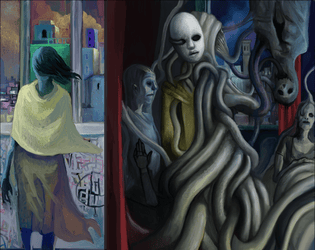
Almost 50 pages of surreal, cosmic, and weird TTRPG goodness. Free!
An introduction to the mysterious case of The Sniper of Ryme.
Visual Novel
A diceless, GMless story game about an immortal hermit.

A game about setting goals, doing one's best, and living with an inexorable curse.

An open ended, system agnostic adventure module.
A Storytelling Game Of Cloaks, Daggers, And Unspeakable Powers

a 200 word tabletop micro-game about cursed musicians on tour
a tabletop game about trying to escape from superficially pleasant but sinister villages

a small tabletop game about being (or lying about being) a time traveler
A tabletop storytelling game about weird sitcom episodes that will never air.

A Premier Hypertext Adventure Experience!
Adventure
Hunt vortices like a pro...to the extreme.
Interactive Fiction
Play in browser


A surreal interactive story about love, community, loneliness...
Visual Novel
Play in browser
Recent community posts
Okay, so this kind of weird me out a little bit.
I can't tell if it's a glitch in the game, or perhaps the last released build of it, or another instance of me being extra obtuse (this is currently my top bet, past me got me again), or some sort of creepypasta style anomaly / "Mandela Effect."
The houses in the residential area are supposed to be numbered. I thought they were numbered. At least I thought the important one was. B ut ... they don't seem to be? I feel like I can distinctly recall placing the numbers in Unity, and playtesting the game with them there, and there being numbers, but, well, I suppose I am misremembering?
Technically, the phrase is in "unit 119," but how one figures out that it's 119 without house numbers is ... well, my currently theory is that you're supposed to refer to one of the notes found in one of the two larger houses across the street and conclude, based on the note, that said house is the one currently being "actively investigated" and then work out the other house numbers based on that one. I haven't yet confirmed whether that actually checks out or not. Maybe I figured that it was a bit of secondary clue, and that the player would be able to figure it out without that knowledge.
In other words, it's not the house with the locked door. It can be accessed without any keys or anything like that. The "in the dark, your light grew strong" hint is ultimately much more useful, relevant, and helpful than the house number, as is the stuff about water churning and electricity. I think the "call for help" may very well have been a secondary hint that really was there for the rhyme. It's amazing how much one can forget in five or six years or so.
No worries. I don't mind answering these, and while I do have regrets about how obtuse the puzzle ended up being (a case of massive overcompensation, due to initial fears of it being "too easy," I think), it only occasionally keeps me up at night :).
The Light hint is tangentially inspired by the Dougie story line, and the line he repeats, but it's a more ... oblique connection, I guess. In the US, the emergency services phone number is 911, and there's a secondary (tertiary really) character in the show who is sort of in the background of the Dougie story and repeats those numbers but not quite in the correct way. Hence the "it came out wrong." That should get you pretty close to it.
I am not sure, to be honest, if there's a locked door there ... I'll have to double check.
Hey,
No worries. The puzzle is VERY esoteric. It's been haunting me for years now. I mean, it was supposed to be really obtuse, since it's technically the only puzzle in the game, but I definitely feel like I overdid it. I took it just a feeew steps further than it needed to go.
Some of the scavenger hunt stuff can be pretty hard to find as well, given how big and janky the game ended up being. I myself had to pop back into the game to figure out where the Air phrase was, which basically means I had to solve one of my own riddles over half a decade after writing it. In short, as long as you're having a good time with the vibe of the game, I don't think asking for help will invalidate your experience. I think one of the other players with a similar issue actually just ended up hacking the final door open from the files, and I honestly feel like that was a perfectly valid alternative solution.
I'll try to start off with hints, but am happy to give more direct info if requested.
The Air phrase is, as the original hint puts it, "close to home," so it isn't in the "glitched" blue city (the one that's kind of large, floaty, and ... really, really blue). It's in the "daylight" apartment area, with the diner and gallery and all that. The color blue is still very much a part of getting to it.
The Shadow phrase is, in fact, in the cave. It can be a bit tricky to spot, if I remember right. Positioning matters.
You're looking for the light phrase in the correct "region" but not quite the right spot / building. "You called for help, it came out wrong," is a bigger clue than it might at first seem. However, it is, culturally, a bit of a US centric clue, I have to admit. A bit of a Twin Peaks, Season 3 reference as well. The way to access the phrase is similar, conceptually, to the way one accesses the Shadow one.
"Gematria" is the search term you're looking for. It's a form of Kabbalistic numerology wherein letters are combined to form numbers. If I was making this game today, I'd probably have included a built in Gematria calculator in the game, but my engine/coding skills were simply not at that level at the time, so it's basically one of those "google it, find a converter online, and play around with it" kind of deals.
Hope that helps a bit, and doesn't simply cause more confusion. Again, apologies for the, um, design foibles / quirks.
itch.io Community » Tabletop Gaming » General » Discussion · Posted in A long and tiring journey to the DarkReach.
Congratulations on your first feature complete game. It really is a big accomplishment.
Now, I am hardly an "industry veteran" or any kind of expert, but I've been designing tabletop games for most of my life, and "trying to break into the industry" for about 10 years now, "trying" being the operative word. I have something like 18 different designs under my belt now, some of them relatively short, and some of them in the hundreds of pages. Most of them, until recently, have been released as "indefinite ashcans," much like your own game. There are a few observations I can offer based on my own, admittedly very specific, experience. I wouldn't exactly call this advice. Just some stuff to keep in mind.
- People really don't care for ashcans all that much, in general. To you, this game is the most precious and unique thing in the world, and understandably so, but to them, well, it's just black words on a white screen, presented in a layout that looks like it could have been directly exported from a google doc. They are busy, and tired, and struggling, for the most part, and it takes a ton of time to read through, understand, schedule, and play a new tabletop roleplaying game. When they see something that they perceive as "generic" they're usually just going to switch off.
- That said, if you format it nicely enough, even without artwork or any fancy bells and whistles, and put it out there, you will likely get the occasional taker - people who at least are interested in checking it out, even if they never play (from the perspective of a player / GM, as opposed to a designer, actually playing a ttrpg, any ttrpg, can sometimes feel like a miracle, depending on one's social situation, schedule, workload, etc.). Most of the time, if and when this happens, they will not tell you about it. You might see a download in your analytics, and that's about it. Every once in a while, someone will say, "hey, I played it, and it was pretty fun," or, "hey, I played it, and it's not for me, but good job making it" or what have you. If you polish it up a bit and put it on here or Drivethru for a few bucks, you'll even make some sales here and there. Never more than enough for a sandwich, but hey, free sandwich.
- Even if it's NOT a plain text ashcan, there's really very little in the way of guarantees if you don't already have either a marketing budget, the ability to afford the convention circuit, and/or basically the time and energy to be a full time marketing executive and spend full time hours doing market research, gathering leads, drafting press releases, etc. Despite the fact that a lot of my games are released as ashcans, I'm actually a professional and classically trained artist, and a fairly decent one. I only did the "indefinite ashcan" thing because I enjoy designing systems enough that, for a time, I was just excited to move onto and experiment with the next idea as soon as I wrapped up writing on the current one, and art takes a ton of time and energy. However, when I decided to move away from that approach and into fully illustrated, professionally laid out, fancy schmancy, presumably more "marketable" projects, I still had massive amounts of trouble, given the very limited resources that I have, getting anyone to notice or care.
My most recent kickstarter had a goal of 3k and featured all kinds of art and plans for a physical book, etc. The book itself was already more or less finished, at 250 pages, and even the quick-start document is close to 50. The campaign just ended less than a week ago, in failure, of course, not even half way funded. The global economy is in shambles right now, and algorithms are increasingly difficult to swim against, so maybe that's part of it, but basically, it's hard enough to get attention when you have fancy, hand-painted images, bona-fides, and press releases. An ashcan is going to have a pretty tough uphill battle simply grabbing a potential player's attention.
- It takes weeks, months, and sometimes years for an ashcan game you put out there to get even one comment or review. I wouldn't be too discouraged if there's no traction after only five days. Besides, this is your first game. It's a very impressive achievement, but you've likely got years of hard work ahead of you if you're interested in being a designer, and that's okay. You might be jumping the gun a bit. Since the game is free, I can assume you're not trying to make bank on this (very few people in the industry can make a consistent living, even those with "successful" projects), so there is really nowhere to rush. The core ruleset of your game may be in a finished state, but I can almost guarantee you that it's not nearly as well written as you'll want it to be in a few years' time, just because that's how things tends to go. You can spend another year, easily, on polish across all areas, and presentation, and never run out of things to do.
In short, I really sympathize with the exhaustion and the fear of crickets, so to speak. The silence can be deafening. But it's just kind of how things go. Again, it's your first game. You did it. You accomplished it. It may very well serve as a great foundation for you moving forward, but there is no need to rush. Even with way more marketing resources than you likely have, it's a crap-shoot, and it's better to manage one's expectations. Your life and survival don't hinge on this, so you can just take your time. Pat yourself on the back, give yourself a prize if you can, celebrate, rest. Then do whatever you want to do, and if you want to keep pursuing game design, that basically just means getting right back to work, usually surrounded by the sound of silence.
This is a general discussion board specifically for tabletop roleplaying games (non-digital storytelling and imagination games that are traditionally played in person and can additionally be played over voice or by post). I think you are looking for a specific developer of digital games, and may have better luck contacting them directly or through one of their game's pages. Again, this board seems to be entirely unrelated to what you're looking for and the developers in question would be very unlikely to see your question. I will be archiving this post now. Good luck finding what you're looking for.
No worries.
With all the recent censorship and delisting controversies going on, as well as the fact that the bundle ended up getting delayed by two months due to some sort of technical or administrative problems at itch, things have just been really rough and stressful this year. I suspect that she had to fight really hard just to get the bundle up and running at all, so I wouldn't be too surprised if she is just really exhausted.
Sorry about your experience, either way. I hope you enjoy the game!
Hey, thanks for reaching out. It's been a while since I'd made a direct sale, which is usually what reminds me to update, but it has been selling as part of the queer bundle, so a refresh is definitely in order.
I'll add 5 community copies for now (should be up within a few minutes of my sending this reply), so you can go ahead grab one at your leisure. When the bundle is over, I'll likely add another batch.
itch.io Community » Tabletop Gaming » General » Discussion · Posted in New FitD Superpunk TTRPG - Disruptors!
I am not much of a supers person, but, at a skim, this looks awesome, detailed, comprehensive, and thus "alive." Clearly the result of a ton of hard work and passion. The layout and graphic design could probably use a few polish passes, but it's already 90% there, and I wouldn't complain if this was "shipped" more or less as is. I think the text blocks could use a bit more breathing room, and some of the maps could be made a bit more cohesive in terms of color and line (I love the "highway map" towards the end, more or less as is). I might have made a few different font choices, but that's a very subjective matter.
Anyways, as I said, it's looking great. I hope you keep up the momentum and continue in the same vein all the way to the finish line!
itch.io Community » Tabletop Gaming » General » Discussion · Posted in How Do You Design Immersive Tabletop RPG Campaigns on itch.io?
Hi David,
When it comes to tips for how to get better engagement and discoverability with itch, the consensus seems to be simple: you don't. Itch is a website that's run by a tiny team, who appear to be quite overworked at the moment, and it isn't really clear how, or even if, they are compensated, once you take into account the overhead costs of running it. Discoverability is kind if a crap shoot on here. It's great for hosting things, but it's not really going to go out of its way to drive traffic to any given page - from what I can gather, it shows brand new things on the front page for a few seconds, and then it's a bit of a feedback loop - if you already have a popular game, it's probably going to get top billing, and if not, then it's more or less buried. Using your itch page as a destination and driving traffic to it from elsewhere is probably your safest bet.
As for popular "interactive campaigns with the spark of engagement" or whatnot, to be honest, I am not entirely sure what you mean? Are you writing a campaign / adventure module? If so, my own advice, which is admittedly worth about two cents, would be to ditch all the "marketing speak" and stop worrying about how well your module does in a "focus group." A tabletop rpg module is only as immersive as the GM and the players can make it at the table (or over discord or whatnot), when they're actually playing it, and you will usually not be present for that. You have no control over it. You're also probably not going to sell many copies. If you're designing it for a popular system, like DnD, you might have a chance at a few extra sales, but this is a niche, within a niche, within a niche. And that too is something we have much less control over than we want to believe.
What you do have control over is, well, the module itself, and since the only sane reason to write / design one is for the pure, unadulterated pleasure of doing so, there is no reason for you to be putting anything into it that doesn't, well, "spark joy" ... not for anyone else, but for you. Immersion for the sake of immersion is a moot point. Players might happily ignore that town with the hundred pages of lore and a full population of NPCs, each with a detailed backstory, or might burn it to the ground by accident, or on purpose. And that's ultimately what makes the ttrpg format inherently immersive. I've run a few absolutely bonkers sessions of Honey Heist, some of the most memorable and fun ttrpg experiences in my life, and the entire premise for those fits onto a single page, and most of the "setting" is randomly generated at the start of the game.
If you're writing a campaign setting or module, make it one that you'd want to play. If other people end up playing it, they'll usually be able to tell that it was made with genuine interest and love, even if it is rough around the edges.
There is a first person grid based dungeon crawler jam that's been running for a number of years now, so you might have seen that one floating around. I have never submitted anything for it (yet), but I usually take the opportunity every year to make progress on my own gridder framework and game during the time frame, as a way to sort of get in on the energy and vibes. The mere possibility that I might be able to submit something is usually enough to motivate me to get a lot of good work done, though I always kind of know in the back of my head that this is not likely (it's an 8 day jam, and I am too disabled to reliably be able to do anything from start to finish in just over a week).
It's a nice community with a lot of nice talented people. My only gripe, and it is a MASSIVE gripe, to be fair, is the fact that generative AI is neither barred nor discouraged. The folks who use it aren't usually malicious, but there is often a generalized ignorance, willful or otherwise, of the problems, ethical, creative, cultural, and environmental, and the negative implications of the "tech" (I use scare quotes because, well, it's not really a unique or new tech at all, just standard transistor based computing dialed to eleven thousand and marketed as something revolutionary, but I digress).
I have to admit, this has also contributed, to a small degree, to my reluctance to submit even unfinished projects in past years. Old school dungeon crawlers are so niche an interest that even I, as someone who frankly hates generative AI with a burning passion, and hates it more and more each passing day, as culture itself becomes increasingly clogged up with slop, not only making it harder for me as an artist to survive (not like it was ever easy), but making it harder for me to find art to enjoy, just can't really bring myself to throw the baby out with the bathwater on that one ... it's generally a decent Jam and community, and I can't even rage against most of the AI users, which make up a minor contingent - I just think they've been duped and bamboozled - most of my rage is usually directed at the companies and the willful exploiters.
That having been said, I am thrilled to see another dungeon crawling jam that has an explicit AI prohibition, has a more general definition of the genre, and lasts a full month.
I've been waiting ... for a jam like this ... to come into my life.
Sorry ... I kind of went off there ... that's sort of what I do, though. No surprises there.
Hey, I'm glad it's caught your eye! I had forgotten just how funky I got with the description, and some of the art. Hope you really do enjoy reading through it and/or playing it. I tried to maintain a similar goofy vibe throughout the book, and I think the system itself has turned out pretty good, though I wish I had had the time and resources to add some more optional and supplemental stuff, like tables, maybe, or even a trial adventure or two. Maybe I'll do a second edition someday.
I doubt we're nearly as worried as you are. I probably speak for just about everyone when I say that we deeply appreciate all the work and energy you've put into this. It's certainly frustrating all around, but I can only imagine how frustrated you must be, and I don't think anyone blames you for this situation.
I'm sorry for the troubleshooting message. In retrospect, I can see how it would only add to the stress of the situation, and I should have realized that you'd already have gone through all of the above steps and more. For my part, I'll take a deep breath and wait patiently. Hopefully, it's resolved soon, and I hope you're able to mitigate some of your worry in the meanwhile.
We also have to approve it once it's ready to launch, yeah? Or did we already do that? I can't remember ...
Anyway, might be worth following up with Support, assuming that this has been a longer than usual wait (which it seems like it has been? - again, I am no expert) and opening a ticket with them, if you haven't already. It may or may not be effective, but that process has helped me facilitate and get the wheels rolling on much less important matters before, like individual payout delays and the such (can confirm that sometimes stuff just plain gets "stuck" in MySQL limbo, or whatever they use here). Could be there's something funky / glitchy going on.
I don't know if you got an official confirmation of receipt from them (assuming so), but it's not impossible that something technical on their end has tampered with things, and that it's fallen through the cracks in the database, so to speak.
Dissociative Community Zine Jam! community · Replied to yumehop in I'm assuming that creators who experience dissociation as a symptom but who do not have DID are permitted ... but just making sure.
Dissociative Community Zine Jam! community · Created a new topic I'm assuming that creators who experience dissociation as a symptom but who do not have DID are permitted ... but just making sure.
What the title says, basically. Again, I have no reason to assume this would be limited specifically to those with DID, but you never know, and I did notice that it was very specifically noted, so a part of me wasn't sure if this was meant to be a jam for creators with DID in particular, or if that was intended to emphasize how DID in particular is commonly misrepresented in the media. Again, assuming the latter here.
Personally, I have PTSD (and comorbid depression, anxiety, and obsessive compulsive features), and seem to suffer pretty severe dissociation, derealization, and depersonalization, to varying degrees and in varying combinations, pretty much 80% of my time awake - I mean, that percent number is just kind of a guess, really. It's a lot is the takeaway.
There's a brief example of play at the end of the PDF. You're not likely to find a Youtube video or anything like that. Aside from "This Town Is Full Of Monsters," which does seem to have a very small following and occasionally gets played on some very indie actual play podcasts and such, most of my games are quite obscure. No marketing budget. Well ... no budget at all, really.
Anyway, I'll go ahead and put a screenshot of the in-book example on the game page so that you and other folks can check that out. Thanks for the question. Again, I don't really know much about marketing or storefront presentation, so these kinds of things sometimes slip through the cracks once I've finished a project and am eager to move on to the next one.
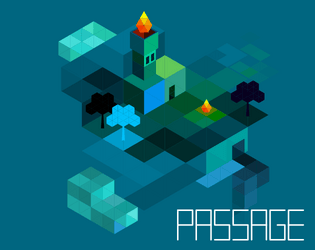
As a quick primer, Passage is intended as a fairly loose, poetic journaling experience, almost like reading an oracle deck, so you're not going to find heavy dungeon crawl rules, monsters, combat, or anything along those lines (I have been wanting to do something like that for a while, but it'd be a lot of work and there's already a ton on my plate right now).
The basic "gameplay" consists of rolling a d20 three times to generate a "prompt" composed of three symbolic Domains / Elements (a Domain is assigned to each face of the die, so you're basically always rolling on one relatively abstract universal table), coming up with a brief interpretation / scene based on the Domains you roll and any previously established narrative context, then choosing an action for your "character" to take in response to the prompt. The next time you roll, the previous set of conditions, and your chosen action, will usually directly inform and influence the next interpretation of the Domains that come up.
Again, I'll put a screenshot of the example page hopefully a few minutes after I hit 'post' on this, so you'll be able to check that out there.
Hi Chris,
This is probably not the same game? Very few people play my games at cons, I would wager, if any. I think the only game I've made that actually has a small "fanbase" right now is This Town Is Full Of Monsters, and maybe Passage as a distant second. Those are much smaller, GMless storytelling games (with Passage being a solo game by default, though it can be adapted for groups), and I suppose they could theoretically generate pretty dark stories, but TTIFOM is the only one that encourages the use of cards, and very optionally at that.
I'd guess, based on your description, that you might have simply played a different game named Spiral, by a different designer? Sometimes that happens, as it can be very difficult to make sure that two indie rpgs don't have the same name when neither author knows about the existence of the other at time of publication?
Or maybe "spiral" was simply the thematic and mechanical core of that system, since it seemed to encourage continual escalation (that sounds like a really cool idea)?
My Spiral, I am afraid, is not nearly as mechanically innovative as that. It does feature a spiraling / cascading fatigue system, which is probably where I got the idea for the name (it was so long ago that I honestly can't remember), but, as you can probably tell from the page count, it's more of a "old school" rulebook for a multipurpose, generalist ttrpg system. Kind of an OSR-ish thing, I suppose. I think I actually started working on it in college, which is, horrifyingly, two decades ago now, and it was basically my attempt to smoosh together the few things I liked about traditional DnD and the BRP system. It's probably the stuffiest and most "formal" system I've written, but I suppose I'm still pretty proud of it. Most of the ones written since have been a lot looser, and smaller.
The DrivethruRPG suggestion is, in fact, a very good one. I do already host all of my (tabletop) games on there under the "brand" Cloudmonster Press. It does generate a lot more organic sales that itch.io (which really generates almost no organic sales to speak of - most come from me occasionally advertising on social media), but they do take a much bigger chunk of the profits, so it kind of balances out. Still, I would recommend any indie designer who wants to make a bit of extra coffee money off their games to always do both.
Anyway, if you find out which game it is that you played, I'd be curious to know as well. It sounds pretty cool.
Sorry for the delay there, but I'll still wish you luck regardless, whether or not you managed to move mountains or not. I am not really big on heavy lifting myself, so I hope that even if you didn't, you still managed to get some good ideas and a few interesting bits of foundation laid down. Whether or not I submit to any particular jam, especially the short ones, is always up in the air, but they can be a good source of ideas and either way.
I figured it was probably something like that... I suppose it's maybe easier to pass off AI music than AI art or writing, due to how naturally abstract music tends to be. I am sure a proper, trained composer could tell the difference - I know I can usually tell a piece of AI art and writing from a mile away, espcially the former - the most advanced looking, fancy, "realistic" AI makes the kinds of "mistakes" that even a total beginner human simply wouldn't (a newbie might have poor shading, inconsistent lighting, or an odd perspective, but we, as a species, don't tend to render things "clipping" through surfaces or floating freely - an observation that speaks a bit to the methods by which these images are machined together out of disparate, scavenged pieces).
It always baffles me, however, when less than scrupulous folks try to scam others by taking on the mantle of competent artists, because, having been a "professional artist" for my entire adult life, and having known many professional artists in my time, I simply don't know where the "profit" step of that equation comes in. Maybe that simply speaks to how terrible I am at the business side of things. Clearly, someone, somewhere has managed to pull this off and run into the sunset carrying a large sack with a dollar sign printed on it, but for the most part you can make hundreds of pieces with your own two slowly breaking hands and maybe see a few bucks here and there, if you're lucky.
Anyways, I'll definitely check out the discord.
I am probably not in the best mental ... situation right now to be accountable to anyone but my own self (plus, there isn't a ton of time left in this jam, and, like, any jam period less than a month is a real crap shoot for me), but I would be more than happy to talk shop, share tips, and even share my code if / when it's done. I am mostly using Godot these days, in case that's a factor.
As a side note, I am finding it kind of perfect for this purpose. It's got strengths and weaknesses, like all engines, but its UI features are a definite strength. I am finding it a lot more intuitive and straightforward than Unity in that regard, which is probably why it's become relatively popular for building non-game applications.
I don't know if just under a week will be enough, as I just stumbled onto this today, but, well, I've been meaning to put together a "simulated OS" framework in Godot (think Her Story or Pony Island), just because, and this might be a nice opportunity to at least get started with that.
Unrelated question, but not worth a separate thread:
Has anyone noticed that almost every community forum on every jam is specifically flooded with sound design and music folks looking for teams? If you're one of those folks, could you explain why that is, or why you think that might be? Is there just a big push in music schools and such towards getting their alumni into the games industry or something? Why are there so many composers popping up everywhere, in numbers greatly disproportionate to those of visual artists, writers, animators, coders, etc. Is it some sort of strange spam? Is it people using AI to generate music trying to pass themselves off as composers for ... profit (if so, how, it's not exactly a historically profitable field, none of the arts are, and being able to churn out endless amounts of low quality stuff has never really made anyone rich)? It can't be because there are more musicians than there are visual artists - music is, like, kind of hard, right? It's one art form that I personally find very difficult to access ... being a jack of (almost) all trades and a master of (almost) none, the ability to compose is one thing that I personally find lies furthest from my reach. I'm just genuinely curious. Maybe more than curious. This fascination has been building up in me for months and months now, and I just can't resist asking. What's up with that?
Now a separate post born of my compulsive pedantry. This is not a comment on the theme itself, but simply an unsolicited pseudo-educational PSA / screed / pet peeve, for anyone who might not know much about this topic and is interested. This might allow such folks to be better informed when invoking the Dunning-Kruger effect in discussions outside of the specific ruleset defined here.
Firstly, there is a lot to suggest that the "effect" itself is largely bunk, or at least not consistent enough to be considered anything beyond ... a phenomenon that sometimes occurs, but not necessarily in a universal correlative or causal pattern. This is true for a lot of experiments and studies in the social sciences, and no shade to Dunning and Kruger themselves. It's just that their results are predictably limited and don't (and perhaps can't) account for the breadth of cultural, social, and individual factors at play. It IS, in my opinion, a useful phenomenon, and potential fallcy / bias, to keep in mind if one wants to live what might be called "an examined life," so it's not like I'd throw the baby out with the bathwater on this one. It's good to constantly examine one's own faults and limitations, and doing so can probably make us all wiser, if not necessarily "smarter" or more competent.
Secondly, and this very much complicates and informs the above, the idea that the DK effect is about inherent intelligence is a common misreading. It primarily deals with the discrepancy between one's actual competence and knowledge, as applied to specific and discrete areas, and one's own perception of their competence and knowledge in that discrete field. Might seem like semantics, but this becomes an important distinction when we, collectively and individually, try to examine ourselves and our biases, because it implies, correctly, that nobody, and I mean nobody, is excempt from this so called effect, regardless of how book-smart or street-smart they are - someone could be a Nobel prize winning theoretical physicist and still easily fall prey to it, perhaps even more so, as they are likely to have an overinflated sense of their own general competence based on their other specific achievements. They might, for example, believe that they can quickly and easily figure out how to fix the engine of their car better than a "common" mechanic, or may underplay the challenges of most artistic pursuits and assume that they themselves are inherently capable enough to paint like Sargent or compose like Beethoven ... if only they wanted to ... but, of course, they simply choose not to try ... because they have more important things to do.
Of course, one can have demonstrable proof of their brain's "above average" cognitive speed and processing capacity, and still fall victim to the effect's flipside, which essentially means that they experience severe imposter syndrome, regardless how many awards or accolates they accumulate, regardless of the fact that they are, objectively, the world's foremost expert on X, and teach a course on X at Columbia. This, of course, is a matter for them and their therapist to sort out. However, pretty much all people are equally susceptible to both sides of the cognitive bias, and there are absolutely various cultural and socioeconmic factors at play that have nothing to do with what we'd call "inherent intelligence." There are plenty of people who, due to circumstances outside of their control, end up "underperforming" in a variety of areas, and blaming this entirely on their own perceived lack of competence and intelligence. Similarly, when someone has had everything handed to them their entire life, they are more likely to feel justified in all kinds of internal Dunning-Kruger nonsense, whether they are actually below average, entirely average, or highly intelligent.
And that's just a really long winded way of saying what most people without my particularly awful brain, and yeah, I recognize both the resonance and the irony in this statement, could probably explain in just one short paragraph.
In short, the actual, real world Dunning-Kruger effect has nothing to do with how "smart" or "stupid" anyone is, and is in fact a cognitive-bias that NOBODY gets a pass on and EVERYBODY can be, and likely has been, at one point or another, affected by - it, in itself, is really just a very messy overcomplication of what I'd consider a fairly solid bit of folk wisdom (i.e. hubris is bad ... remember, thou art foolish ... etc.)
I'm still deciding on this one ... Might actually give it a go this year, depending on scheduling stuff. I am not personally a huge fan of the mythology surrounding the DK effect, nor do I get much of a charge out of most stories that place a hapless intellectual "ugly duckling" in a sea of foolish intellectual "swans," but therein might lie the potential for an interesting challenge...maybe. If my OCD driven pedantry can get past the initial hurdle. That, I suppose, is my own albatross to bear.
I do have one question / clarification request.
When you specify that [the fact that the MC is "smart"] "can't be revealed until the end," do you mean to the audience / player of the game, or the protagonist? I am assuming it's the latter, because the former option feels like it'd be close to impossible to execute without obfuscating the theme itself (i.e. if the unwitting player can't tell that the MC is the most competent person in the game, either througout the entire game or until the end, then how could the judges possibly know for sure if the game is even adhering to the constraint and isn't about a character who is actually the least competent person in a milleu of incompetents), but making sure, just in case,
Thank you. I am always so happy to hear this sort of thing. The kind of stuff I'm into making tends to be pretty niche, so I don't hear from players / readers / etc. very often, but learning that someone has had a genuinely memorable experience with one of my creations helps me keep going.
The confusion and fragmentation are, of course, part of the intended experience. I will say that there is an underpinning narrative that I personally subscribe to, and a few interpretations I've heard that I think are just as valid, but I'm the sort that likes to let people come up with their own readings and don't want to explain too much. I'm a big David Lynch fan (which is probably obvious) so I tend to subscribe to his viewpoint on art, narrative, and mystery - if everything is explained by some canonical "voice of god" / authorial figure, then the mystery dies and the story simply ends. There is nothing inherently wrong with that - there are a lot of excellent stories out there that are neat, tidy, and linear. But I think effective surrealism, and surrealist mystery, is all about trying to get the questions and incongruities of the story to take up residence in the audience's head rent free, and stay there as long as possible.
So, you know, I'm really glad that it had you wondering! And again, thanks for the kind comment!
Hey, sorry for the delay. First of all, thanks for playing, and I'm so glad you've enjoyed it!
If I am understanding correctly, you can get a clue to the second warp in the Tuner facility from one of the "generic" (flat texture) NPCs who hang out in the "observation deck" area right outside the spawn in. Of course, not all warps go to different places, so you've probably already accessed the location this one leads to from a different world. I think it leads to the dark / empty version of the desert area. I think the only other portal in the facility is the "normal" one, past the door that unlocks after you pick up the Tuner.
As for the combination lock, I will be the first to admit that the puzzle that guards it is ... unreasonable. To some extent, I guess that was a matter of "artistic vision" winning against good game design. I got pretty enamored with the idea of a "secret area" that was so hard to get to that it might as well be an urban legend ... I am not sure I can say that I "regret" it per se, but I definitely understand the frustration it causes.
Anyways, I think there's actually a thread in this very discussion board, from a couple of years ago, wherein a few folks and myself go into a bit of detail on how to solve it. I think one person actually did. Another person went into the game files and simply removed or opened the door, and frankly I salute them. I think that also counts as solving it, from a meta sort of perspective.
In any case, I think that thread should help, but I can also try to look up the solution in my files.
Word. I mean, most people would call the Zero Escape games "visual novels," even though they have a bunch of very puzzly and gamey puzzles in them. Speaking to the vague nature of the label, interestingly enough (to me personally, at least ... I just find this particular case really fascinating), there are too many people that disparage Persona 3 Portable for being "just" a visual novel - despite the fact that it has exactly the same core gameplay loop as every other version of the game, the exact same story, the exact same level of interactivity and choice, the exact same Tartarus grind, and at least double the amount of content, even when compared to the recent remake. And those same folks rarely call Persona 5 or the aforementioned remake "just visual novels," even though, ultimately, they are like 80% visual novel mechanics with 20% of dungeon crawling sort of ... attached.
Genre labels in games, and by "gamers," are a trip sometimes. But I digress.
I doubt this would be a problem. In fact, it's not really all that unconventional. While there are ostensibly fewer DRPGs that use that kind of system than those that use more of a jrpg style turn based one, it's a pretty natural fit and is hardly unheard of. There are also some hybrids around. Legend of Grimrock uses a similar movement model, but, instead of simultaneous moves, has it happen in real time.
A simultaneous turn system along those lines is also not the worst to code, though pathfinding and AI are always kind of a pain, and this framework can end up being more structurally complicated. I made a prototype of this kind a while back, and I'm hardly the best coder. So if I can do it, it's probably quite achievable across the board. That said, if you want to implement it from scratch in under 8 days, along with doing everything else, it'll certainly be a challenge.
But then, I guess that's kind of the point.
Dungeon Crawler Jam 2024 community · Posted in Can you guys suggest a game in this style to get-myself ready with the trope?
Grimrock does, indeed, fit into the format. The Grimrock games are an example of one of the two broad, most common subcategories in that they have essentially real time combat/interaction on a grid, wherein the players, traps, monsters, and etc. can act on their own. If you go afk without pausing in Grimrock and there's a snail coming at you, it will eventually reach you and kill you without any input from you directly. I enjoy LoG a great deal, but it's not really my favorite scheme simply because it can lead to some really awkward juggling and strafing gameplay on occasion. It's not bad by any means. I just prefer to take my time.
The other most common format is essentially grid movement, just like Gridrock, mixed with "JRPG" style turn based battles. I put that in quotes just because the actual provenance of this particular mode of gameplay is more complicated than it simply being western or Japanese in origin. I suppose the whole Drpg genre owes the most to the old Wizardry games, which basically showcase the journey these mechanics took across the world, with Wizardry being a western game that happened to make it big in Japan and ultimately contributed to the genre fluorishing over there (while it largely stagnated here, until indie gaming started to sort of give it a bit of new life). Wizardry itself, the IP, was eventually bought out by a Japanese company, with the most recent installments being Japanese in make and origin.
But I digress.
The older Wizardry games featured "JRPG style" turn based combat. I haven't played all of them (and none of them to completion), but I think most of them were turn based? Wizardry 8 is a departure to some extent in that it uses a sort of hybrid "real time with pause" sort of system. Anyways, a lot of DRPGs use that combat paradigm to the this day, with the more real-time variant being less common, as far as I can tell. Sometimes it's got random encounters, sometimes monster icons roam the map and you gotta collide with them to initiate turn based combat, sometimes it's a mix, and of course the actual combat mechanics can vary widely once you're in it, but the core is very much the same.
There's a third possibility I see occasionally (and have played around with designing myself) that's more akin to the old school Rogue style of movement and combat. Basically, enemies, traps, and the player move on the grid, just as they do in Grimrock, but every movement and action takes a "turn" and standing still does not progress time. So enemies only move when you move, basically. I am bit more of a "turn based JRPG" girlie myself, but I also like this modality quite a bit, since it combines the added immersion of the real time format with the ability to take your time and strategize.
As for which one is easiest to make, well ... I've tried them all in my time, and I honestly can't say ... they all have their own pitfalls and challenges, and I imagine it might vary widely from person to person. One nice thing about taking the turn based JRPG approach is that you don't have to implement pathfinding AI and such, so that's probably what I'd generally go with in a time crunch scenario.
But, yeah, as to your question, examples ...
For real time, I wouldn't really recommend going too far back (or too hardcore old school) if you're new, simply because that experience can get quite rough and frustrating. The more user friendly and modern Legend of Grimrock games is about the best bet. If you're looking for more of that, the Vaporum games are pretty great in most aspects. I haven't played Lockdown yet, but really enjoyed almost everything about the first one ... besides the writing and the story, which were competent but just not to my taste. The dungeoneering, encounter design, combat, puzzles, were all very enjoyable in it.
To check out the turn based variant, well, there are a lot of options ... Again, I probably wouldn't recommend going too far back, but you wouldn't have to, as they are getting made to this day. Unfortunately, since they are a bit of a niche within a niche within a niche, the newer ones tend to get released for AAA prices or close. I had a fabulous time with Undernauts, and absolutely loved Labyrinth of Refrain and Labyrinth of Galleria, and I think all of the above are fairly accessible for newcomers, but of the set, only Refrain, being the oldest of the three, is particularly affordable, usually sitting at just under 20 bucks. You may want to try and catch a sale, or maybe pick up a physical copy somewhere second hand, if you can. I obviously think it's worth supporting these studios because, you know, I happen to love this subgenre and want more of it, but money is hard, and if you're not sure what you're getting, or if you'll even like it, it can be a tough sell.
Going slightly older, Shin Megami Tensei: Strange Journey Redux runs very well on Citra ... though OF COURSE you'd first have to own a physical copy of the game, OOooobviously (either way, Atlus isn't exactly going to be hurting for cash any time soon, and DS and 3DS game access and preservation are a mess, so, you know, do with those opinions what you will).
And, of course, there are a ton of fun, free examples made by participants of this very jam in years prior.
Hmm, my Playnite picks up my itch.io games no problem, including free ones, I think, so long as they are listed in my itch library. However, I do have the itch.io app installed on my PC, and it's possible that Playnite is drawing its data directly from the app, and not from the account itself (since all it really does for pretty much any game from any platform is open up the platform - so, if I click on a steam game in Playnite it will open steam, if I click on an Epic game, it will open Epic, etc.?) It seems to piggyback off of the existing launchers, is what I mean. Do you have the standalone itch launcher installed?
That aside, you can also add games manually by creating an entry and pointing it at an executable. You can also even get emulators and emulated games listed (with all proper legalities considered, of course).
itch.io Community » Tabletop Gaming » General » Discussion · Posted in Journaling / Map-making tabletop games/activities that can be used in an ESL context
I wish I had more time to actually explore everything that's been put out over the years. It's a veritable trove. But most days I have a hard enough time just getting out of bed, and it's not like there's often an opportunity to actually play these games - they end up being more like ... mental artifacts, I guess. I wrote one of these several years back. It's called Passage and is basically a prompt generation engine for a solo adventure / dungeon crawl / divination. It doesn't really have a built in setting or theme, but tends to work pretty well for solo runs comprised of short actions or scenarios. There are probably some community copies still on there, but if not, you can let me know and I can hook you up.
I used to be an ESL kid, back in the olden days. I don't really remember much of what we did in class, to be honest, but I certainly wish it was more along the lines of tabletop roleplaying games. Maybe then I'd actually remember. To be fair, at that age one doesn't stay in ESL for very long. The combination of pressure and immersion is one hell of a drug. I think I was fluent in something like three months after touching down on American soil for the first time. But, you know, you have to finish out at least the semester, so I am pretty sure it got real boring after a while. A bit of gaming could have livened it up.
To be completely honest, this is about as broad a theme as one could ask for. This isn't a bad thing, but I'd be surprised if it threw too much of a wrench into anyone's existing plans. I mean, a seven day jam is hard enough, I suppose, without an overly restrictive theme, so it works out. You could literally take any idea you wanted, tilt the lens ever so slightly to fit the theme, and you'd be fine. We tend to fixate on duality as having to do with binaries and the number two, but that's not ultimately what the word in its fullness refers to, having to do more with separation and separateness between discrete ideas or entities - they don't have to be opposites, and there doesn't even have to be two of them, since any act of "splitting" is a manifestation of duality, so if one thing splits in two once, that's duality, but then if one of those halves splits into two again, that's also duality, resulting in the number three, and if all of them split a third time, well, that's Numberwang!
To put it another way, non-duality is a state of unity - not multiplicity. Three, five, six, or five thousand are not examples of non-duality. A non-dualistic view of the universe, for instance, emphasizes the illusory nature of the perceived separation between all things.
Of course, even if you were to stick to binaries, opposites, strict dichotomies, and/or the number two, you're still unlikely to ever have a shortage of possibilities and options, because almost everything comes in pairs and almost everything comes as part of a dichotomy. Did you want to make an SMT clone / tribute? You've got duality baked into that whole franchise. Does your game take place in a hierarchical society? There you go. Sure, the good and evil dichotomy is everywhere and might feel a bit cliché, but at the end of the day it's those things for a reason - the conflict is immediately relatable and has clear, identifiable, and real stakes that are pretty much always relevant to the human condition. And there is no one way you have to go about it. Twin Peaks and The Lord of the Rings are both about that same duality, and one is among the greatest and most unique sagas known to man ... and the other is Lord of the Rings.
Anyways, despite the above spiel ... I probably won't even be able to submit a game for this, because I am WAY too mentally ill, old, and tired to do jams shorter than a month long (at least in my particular case, this sort of thing just doesn't fly anymore, sadly). Still, I am super excited to see what everyone comes up with, and will probably spend the week working on a game just to ride the vibe, so to speak.