On Sale: GamesAssetsToolsTabletopComics
Indie game storeFree gamesFun gamesHorror games
Game developmentAssetsComics
SalesBundles
Jobs
TagsGame Engines

Deck-Month 3 WIP Thread!

A topic by ahmwma created 18 days ago Views: 423 Replies: 24
Viewing posts 1 to 8
(+7)

It's jam time again! We've only just begun but it's nice to have a place to talk about how the event is going.

Feel free to post about what you're working on! Anything is welcome from ideas to sneaky peek screenshots to letting us know you've published your project.

Good luck everyone and Happy Deck Month!
(+5)

I have the idea bouncing around in my head of making an FMV game in Decker. That's my primary plan for Deck Month at least.

(+2)

oooh that sounds so cool! i can't wait 👀

(+3)

I made it happen! It is mostly a tech demo, and even with such a short game the file size is kinda big https://micpp.itch.io/select-a-friend but it worked.

(+2)

And I ended up doing a second project as well haha, this one is less technologically interesting but probably more artistic https://micpp.itch.io/a-nice-anime-date


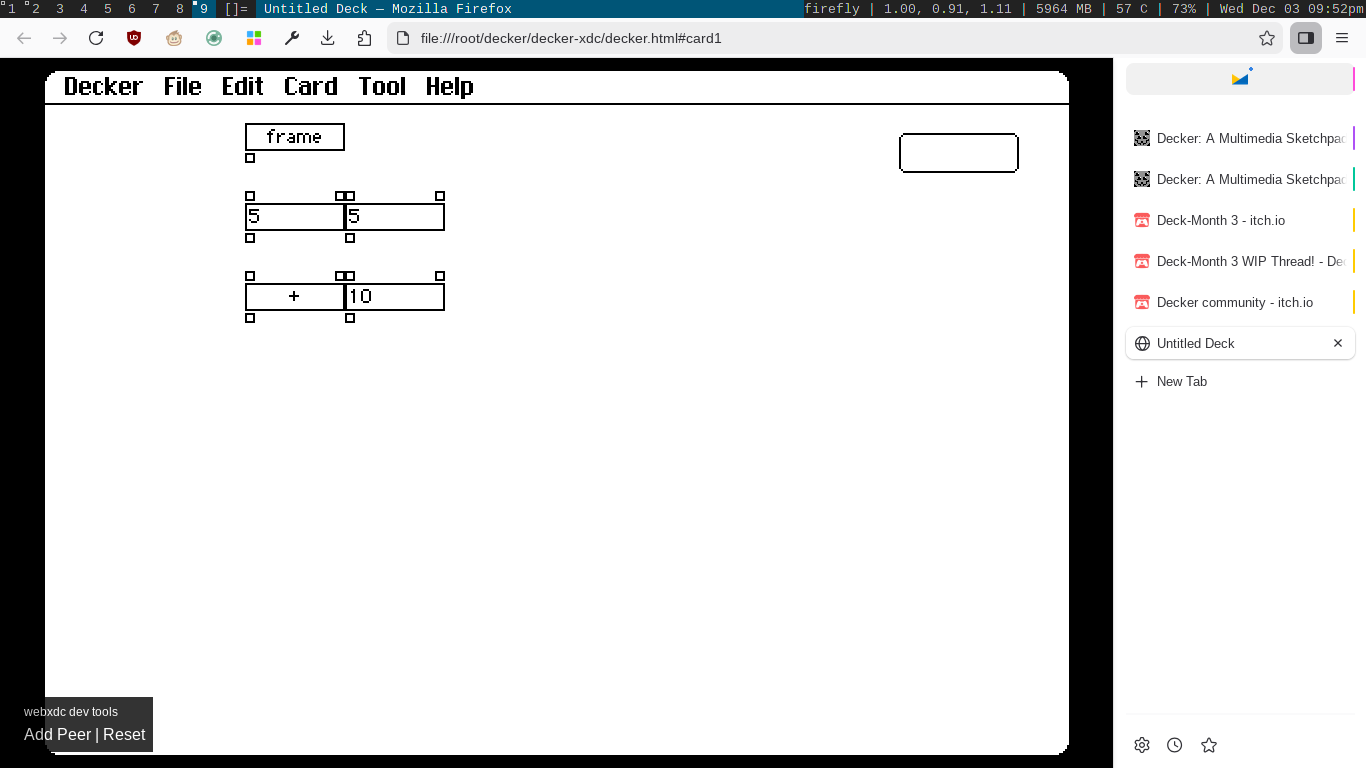
I’m working on dP (decker Pipes) - a Pd-like in Decker.

Also, Milly - if I can get your permission - I’d like to use Janky Sequencer as an input demo for dP. (I hope it works and not over promising…)

(Also, I know ‘dp’ stands for other things… but that makes it amusing.)

To be honest, I am not sure what it does or is about - I might ask if you can explain in simple terms if that's OK?

(13 edits)

Pd (Pure data) is a flow graph based programming environment, primarily, for real-time audio processing. It was made by Miller Puckette and also worked on Max/MSP <- (hence the name MSP).

Pd, along with Max/MSP/Jitter, are used for deejaying and veejaying, along with general audio and video processing. For instance, I have a Pd patch that I made for my computer to mix various audio sources, along with a custom equalizer, bs2b filter from scratch, etc. (I once used Max to do real-time special effects for a university play in collaboration with the theatre department and a computer graphics offshoot of the art and design college. Anyways.)

So, I want to see if I can do real-time audio processing on your sequencer. I hope I can squeeze enough cycles out of it to do something.

For the most part, dP is an experiment of mine for tinkering with data flow graph processing, because it can do more than audio - general programming. It could be something non-programmers could use for Decker. Audio engineers and deejays/veejays make their own Pd patches. Flow graph programming is frequently used in visualization tools, like VTK and ParaView, for instance.

It’s interesting to me because flow graph and graphics (my background) programming, in general, very much have a “feed-forward” view of programming - kind of like React or Unix pipes (hence, decker Pipes). It’s more procedural, event-loop, like a factory or process engineering view of programming - not a math based view of programming, which is more “call-back” or “inside-out,” in my opinion.

At least, it will be a neat toy that I hope to do some audio manipulation with your sequencer. (I’m not trying to oversell this as taking over the world, as flow graph programming has been around forever. It’s just an experiment of mine.)

(+1)

Ahh, I'd say go ahead then! Although with how I do the audio output (basically just generating individual samples for each note, playing them back based on Decker's frame timing and letting Decker take care of the mixing) it may be hard to pipe the output to anywhere else since it's not like a conventional stream of audio as such.

(+1)

Yeah, thanks for the heads up. I was looking at the Janky code already, and had thought about it, too.

So, it’s not going to be a 1-for-1 emulation of Pd - because of that. I’m not sure Decker could handle the amount of processing. Maybe, maybe not.

But, I think a sound queue should suffice and give the appearance of realtime.

Oh, I should mention - the above picture runs in real-time already. I can type in where the 5s are, a different number, and they will automatically add up in real-time. That’s why it shows 10.

It’s just that I don’t have a visualization for the connections/wires/inputs and outputs, yet, so you can’t see them connected together. Because the output of “frame” connects to the first 5 box, the 5 box connects to the second 5 box, so the number gets copied, and then they both feed into +, and then plus outputs into the final box to show you 5+5=10.

(+5)

I'm thinking about making a visual novel about smth like a war machine that just wants to play piano (inspired by naoki urasawa's pluto). she visits a time traveling nekomata's (2-tailed cat) bakery where the trans catgirl baker is a human weapon that just wants to make cookies. she does this for years and years in the memory of "her master" she met in another timeline. her master's only wish after the fantasy palace imperial asian war was over was to perfect the cookie recipes that reminded him of his childhood. the pianist is an older / alternate universe version of her master. whether they fall in love or not is ambiguous, but the door is open. 

Deleted 6 days ago
Deleted 6 days ago
(1 edit) (+1)

Halfway through the jam!  I'm curious to hear how other projects are coming along. For me, it was slow-going at first, as I learned the ins and outs of Decker; but now I'm loving it, and my project is moving along nicely.  It's so much fun to create retro-looking graphics, and I keep thinking back fondly to Myst and the Sierra games of the 80s and 90s.  I'm hoping to have at least six scenes and nine or ten puzzles by the time the jam concludes.  Here's a little sneak peek at the third 'scene':


(+1)

Ooh, I love a good puzzle thing! I'll be looking forward to checking it out!

What did you use for the background art? It looks like it's done in something external and imported into Decker?

(1 edit) (+2)

it's funny actually.  i used a very high tech method to get a low tech look!  i placed a virtual camera inside a fully-rendered, full-colour 3D environment, chose the view i wanted, took a screenshot and imported the low res, black and white version into Decker.  just like traveling back in time!

(1 edit) (+2)

then i added the silhouettes, which was interesting because I had to position them carefully to give the illusion that they're part of the 3D environment

(+1)

Oh cool! If you haven't seen it, the "All About Color" deck that comes with Decker has some stuff about importing images that could help you have different effects e.g. using different palettes or using an external tool to dither it!

(+1)

sweet!  i will check it out right now.  Thanks for the tip, Millie!

(+1)

this is so good to know.  on the one hand, i wish i'd known how to import images properly before I started; then again, I actually like the weird aesthetic my game has right now.  but i'll definitely use these techniques on my NEXT Decker project.  some of the images in this game are like Rorschach tests - you have to squint to figure out what you're looking at.  :-)

(+1)

I mean I wouldn't say "properly" it's just different! There's definitely cases where one would rather not have dithering after all!

(+3)

by the way, I noticed the Reversible Octopus plushie in your FMV project, so I had to show it to my daughter (she has one and loves it more than any of her 10,000 squishmallows).  Needless to say, she's your biggest fan now.

(+2)

ahh wow thank you!

(1 edit) (+1)


dP update. Now, comes the grunt work of adding more objects.